

How to Build an AI-Powered Telegram Customer Support Bot Using No-Code Automation (n8n/Make): Step-by-Step Guide for Small Businesses
📋 TABLE OF CONTENTS
- 1. Introduction to AI Customer Support in 2026
- 2. The Strategic Value of AI Telegram Bots
- 3. Deep Dive into No-Code Automation: n8n vs. Make
- 4. Strategic Planning: Features, Scope, and Personality
- 5. Technical Setup: Initializing Your Automation Hub
- 6. Telegram Integration: Bridging the Connection
- 7. AI Brain Integration: From Static to Intelligent
- 8. Workflow Architecture: Step-by-Step Construction
- 9. Comparison Analysis: Choosing the Right Platform
- 10. Deployment Strategy and Continuous Optimization
- 11. Interactive FAQ: Expert Answers to Common Queries
- 12. Final Thoughts and Future Outlook
1. Introduction to AI Customer Support in 2026
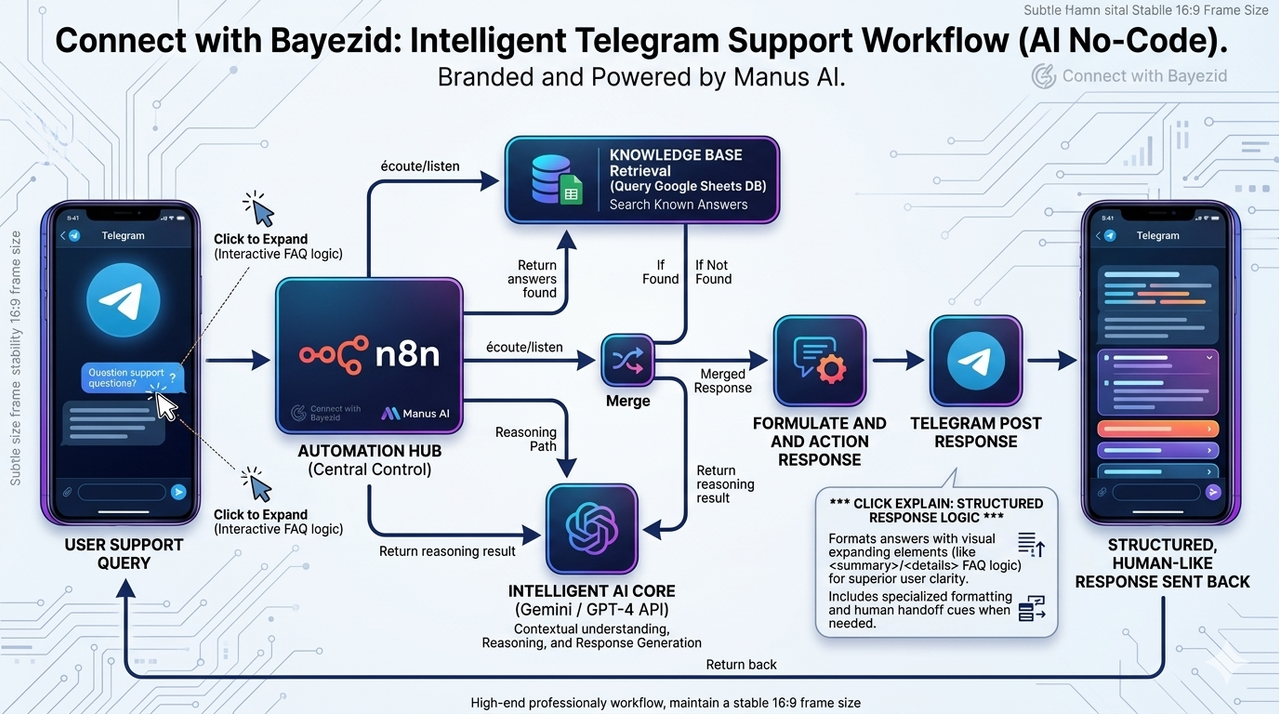
In the rapidly evolving digital landscape of 2026, the phrase "customer is king" has taken on a new dimension. Small businesses no longer compete just on product quality but on the speed and intelligence of their response. Artificial Intelligence (AI) has transitioned from a luxury tech feature to a fundamental business necessity. For the modern entrepreneur, the challenge isn't whether to use AI, but how to deploy it efficiently without a massive development budget.
This is where no-code automation enters the scene. Platforms like n8n and Make have democratized the ability to build sophisticated, AI-driven tools that previously required a team of software engineers. Specifically, AI Telegram support bots have emerged as the gold standard for direct-to-consumer communication. Telegram’s open API, combined with the reasoning power of models like Google Gemini or OpenAI’s GPT series, allows a small business to provide 24/7, human-like support at a fraction of the traditional cost.
In this comprehensive 2026 guide, we will explore the exact steps to build your own autonomous support agent. We will cover everything from the initial bot creation via BotFather to the complex logic of AI prompt engineering and knowledge base integration. Whether you are a tech enthusiast or a business owner looking for an edge, this guide is your blueprint for the future of customer engagement.
Expand Your Business Knowledge
Looking for comprehensive strategies to grow your enterprise in the coming years? Dive into our detailed guide on B2B success.
Read B2B Guide 2026 →2. The Strategic Value of AI Telegram Bots
Why Telegram? While other platforms have restrictive APIs or high costs, Telegram remains a haven for automation. For a small business, an AI bot isn't just a "chatty assistant"—it's a multi-functional asset that works while you sleep. By 2026, over 80% of routine customer interactions are expected to be handled by AI, and being an early adopter in your niche provides a massive competitive advantage.
Consider the scalability factor. A human support agent can handle maybe 3-5 complex chats at once. An AI bot powered by n8n or Make can handle thousands of simultaneous inquiries without breaking a sweat. This ensures that even during a viral marketing campaign or a product launch, no customer is left waiting in a queue. Instant gratification is the primary driver of customer loyalty in the current market.
Furthermore, the consistency of information is unparalleled. Human agents, despite their best efforts, can provide varying answers based on their mood or training level. An AI bot, connected to a centralized knowledge base, ensures that every customer receives the most accurate, up-to-date information every single time. This reduces the risk of misinformation and builds a reliable brand image.
3. Deep Dive into No-Code Automation: n8n vs. Make
To build your bot, you need an "orchestrator"—a tool that connects Telegram to your AI brain. In 2026, two platforms dominate this space: n8n and Make. Understanding the nuances between them is crucial for your long-term success. Both tools eliminate the need for coding, but they offer different philosophies regarding data control and user experience.
The Power of n8n
n8n is often the choice for those who want total control. Being open-source and self-hostable, it allows businesses to keep their data on their own servers—a major plus for privacy-conscious industries. Its visual editor is incredibly flexible, allowing for complex logic that rivals traditional programming. If you're looking for a cost-effective way to scale without being hit by "per-operation" fees, n8n is your best bet.
The Simplicity of Make
Make (formerly Integromat) is the pinnacle of user-friendly design. Its "bubble" interface makes building workflows feel like playing a game. With thousands of pre-built connectors, you can link your Telegram bot to your CRM, email, and AI in minutes. For businesses that want to "just get it working" without worrying about server maintenance, Make is the undisputed champion.
Account Security & Recovery
Concerned about getting locked out of your Facebook account? Learn how to use unlock codes and regain access quickly with our expert guide.
Get Recovery Guide →4. Strategic Planning: Features, Scope, and Personality
A common mistake is rushing into the build without a plan. Your AI bot needs a defined identity. Is it a professional corporate assistant or a friendly, emoji-loving helper? This "persona" should be reflected in your AI prompts. A well-defined personality makes the bot feel less like a machine and more like a helpful extension of your team.
Mapping out the conversation flow is equally important. You must decide what happens when the AI doesn't know the answer. This is called the fallback strategy. In 2026, the most successful bots use a "Hybrid Model": the AI handles 90% of queries, but if a customer expresses frustration or asks a high-stakes question, the bot seamlessly notifies a human agent via Slack or Email. This ensures that no critical issue falls through the cracks.
Finally, identify your data sources. An AI is only as smart as the information it can access. Will it read from a PDF of your manual, a Google Sheet of FAQs, or live data from your website? Centralizing this data ensures that when you update a price on your sheet, the bot immediately knows the new price. This "real-time synchronization" is the hallmark of a professional-grade support system.
5. Technical Setup: Initializing Your Automation Hub
Setting up your environment is the first technical hurdle. If you choose n8n, we recommend using Docker for a stable, portable environment. This ensures that your bot remains online even if you update your server. A simple command like docker run n8nio/n8n gets you started, but for a production bot, you'll want to set up persistent volumes to save your workflows.
For Make users, the process is even simpler. You create an account, start a new "Scenario," and you're ready to go. The key here is setting up your connections. You'll need to securely store your API keys for Telegram and your AI provider. Make’s built-in credential manager is excellent for this, keeping your sensitive keys encrypted and away from prying eyes.
Mastering Autonomous Agents
Explore the cutting-edge world of AI with our complete guide to Manus AI and autonomous agents, understanding their capabilities in 2026.
Explore Manus AI →6. Telegram Integration: Bridging the Connection
The heart of your bot lies in its connection to Telegram. This is handled by BotFather, Telegram's own bot for creating bots. By sending /newbot, you'll receive an API Token. This token is the "secret key" that allows n8n or Make to send and receive messages on your behalf. Never share this token publicly, as it provides full control over your bot.
Once you have the token, you set up a Webhook. In automation terms, a webhook is like a digital doorbell. When a customer sends a message to your Telegram bot, Telegram "rings the doorbell" of your n8n or Make server, sending over the message data. This allows for near-instant responses, creating a smooth, real-time chat experience for your users.
7. AI Brain Integration: From Static to Intelligent
Now for the exciting part: giving your bot a brain. In 2026, integrating Large Language Models (LLMs) is a matter of connecting an API. Whether you use OpenAI's GPT-4 or Google's Gemini 2.0, the process involves sending the customer's question along with a set of instructions (the "System Prompt").
Prompt Engineering is the secret sauce here. You don't just say "answer this question." You tell the AI: "You are an expert support agent for [Company]. Use the provided context to answer helpfully. If you don't know the answer, politely offer to connect the user to a human." This level of detail prevents the AI from "hallucinating" (making things up) and ensures it stays on brand.
Academic Edge with AI
Students, unlock your full potential! Discover the best free AI tools available in 2026 to supercharge your studies and research projects.
See Student AI Tools →8. Workflow Architecture: Step-by-Step Construction
Building the workflow is like building a LEGO set. You start with the Telegram Trigger, which captures the incoming message. Next, you add a Logic Node to clean up the text (removing extra spaces or emojis). Then, you query your Knowledge Base (like a Google Sheet) to see if there's a direct match for the question.
If no direct match is found, the workflow proceeds to the AI Node. Here, the AI analyzes the question and the context to generate a response. Finally, the Telegram Send Node delivers that response back to the user. This entire process, from user message to AI response, typically takes less than 2 seconds, providing a seamless experience that rivals human interaction.
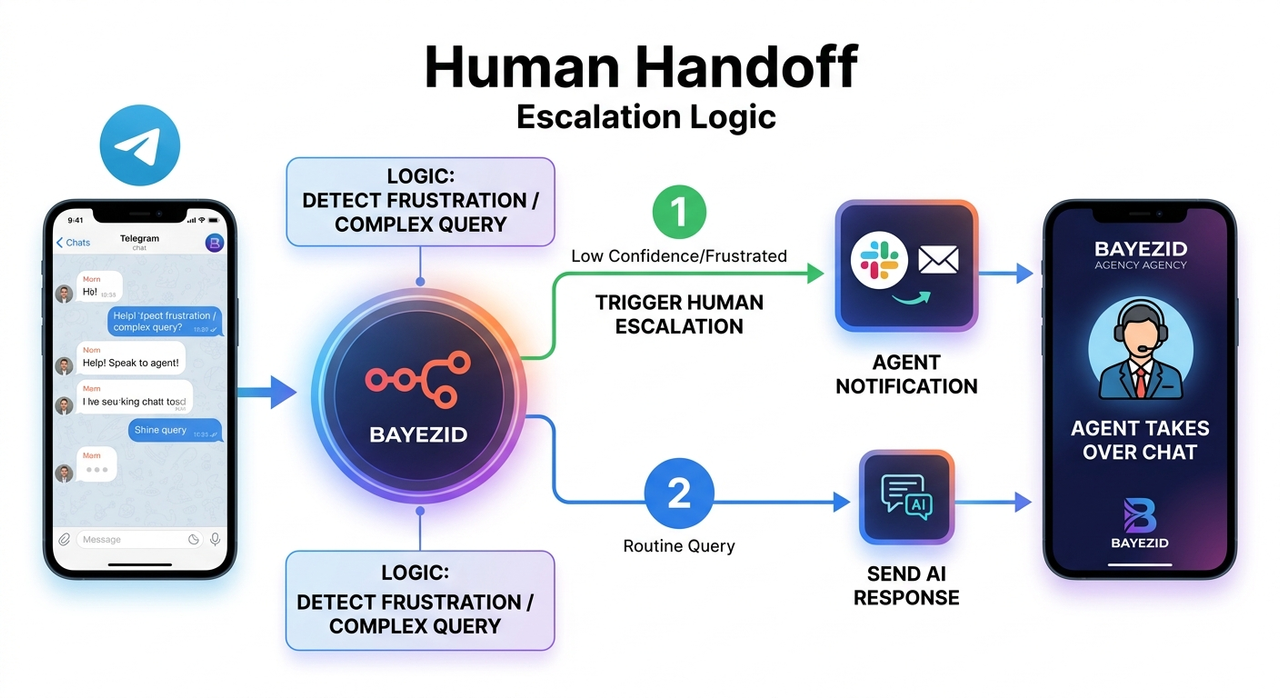
Figure: Advanced Workflow Architecture with Human Escalation Logic.
ঘরে বসে অনলাইন ইনকাম: ২০২৬ সালের সেরা ডিজিটাল স্কিল
আপনার ঘরে বসে অনলাইন আয়ের সুযোগ খুঁজছেন? ২০২৬ সালের সেরা ৫টি ডিজিটাল স্কিল সম্পর্কে জানুন এবং আপনার ক্যারিয়ার গড়ুন।
ইনকাম স্কিল গাইড দেখুন →9. Comparison Analysis: Choosing the Right Platform
To help you decide which tool fits your business best, we've compiled this detailed comparison table based on 2026 industry standards and user feedback.
| Feature | n8n (Self-Hosted) | Make (Cloud) |
|---|---|---|
| Setup Complexity | Moderate (Requires Server/Docker) | Very Low (Browser-based) |
| Data Privacy | Maximum (Your own server) | High (Encrypted Cloud) |
| Cost Scaling | Fixed (Server cost) | Variable (Per operation) |
| Integration Library | 400+ Nodes (Highly Customizable) | 1500+ Apps (Ready to Use) |
| AI Capabilities | Excellent (Built-in AI Nodes) | Excellent (Dedicated AI Modules) |
10. Deployment Strategy and Continuous Optimization
Before you go live, you must stress-test your bot. Ask it confusing questions, use typos, and see how it reacts. A robust bot should never "crash"—it should always have a polite fallback response. Once you're confident, deploy it and monitor the logs. In 2026, the best practice is to review the bot's conversations weekly to identify "gaps" in its knowledge.
Optimization is an ongoing journey. As you receive more customer queries, you'll notice patterns. You can then update your knowledge base or refine your AI prompts to handle these new patterns more effectively. This continuous feedback loop is what separates a mediocre bot from an exceptional customer support experience that drives sales and loyalty.
AI Prompt Engineering শিখে ক্যারিয়ার গড়ার পূর্ণাঙ্গ গাইড ২০২৬
এআই প্রম্পট ইঞ্জিনিয়ারিং শিখে কীভাবে একটি সফল ক্যারিয়ার গড়বেন? ২০২৬ সালের জন্য একটি পূর্ণাঙ্গ গাইডলাইন এখানে দেওয়া হলো।
প্রম্পট ইঞ্জিনিয়ারিং গাইড →11. Interactive FAQ: Expert Answers to Common Queries
A: Not necessarily. Using self-hosted n8n, your primary cost is a small server ($5-10/month) plus minimal AI API fees. Make offers a generous free tier for starters. Compared to hiring a support agent, the ROI is massive.
A: Yes! Advanced workflows often use a "Routing Model" (like GPT-4o mini) to classify the question, and then send it to a specialized model (like Gemini for data analysis) for the final answer. This optimizes both cost and quality.
A: If you handle sensitive data, self-hosting n8n is the best path. Ensure your server is behind a firewall and use HTTPS for all webhooks. Always include a privacy disclaimer in your bot's welcome message.
A: Modern LLMs are naturally multilingual. You can instruct the AI to "detect the user's language and respond in the same language." This allows your small business to serve a global audience instantly.
A: Since your automation hub (n8n or Make) is hosted in the cloud or on a server, it remains online 24/7. As long as the customer has internet to send the message, the bot will be there to answer.
12. Final Thoughts and Future Outlook
The integration of AI and no-code automation is not just a trend—it's a paradigm shift in how business is conducted. By building an AI-powered Telegram support bot, you are future-proofing your business, ensuring that you can scale without sacrificing quality. The tools are more accessible than ever, and the potential for innovation is limited only by your imagination.
As we move further into 2026, we expect even deeper integrations, where bots won't just talk, but act—booking appointments, processing refunds, and managing inventory autonomously. By starting today, you are positioning yourself at the forefront of this revolution. Take the first step, build your bot, and let AI empower your business to reach new heights.

No comments:
Post a Comment